

The exploration of color theory has deep roots in human history, tracing back to ancient civilizations that sought to understand the nature of color and its effects on perception. The earliest documented theories can be found in the works of Aristotle, who posited that colors were derived from the interplay of light and darkness. He categorized colors based on their relationships to one another, laying the groundwork for future explorations into color.
However, it was not until the Renaissance that color theory began to evolve into a more systematic study. Artists like Leonardo da Vinci and Michelangelo began to experiment with color mixing and the effects of light, leading to a more nuanced understanding of how colors interact in art. In the 18th century, Isaac Newton made significant contributions to color theory through his experiments with prisms.
By passing white light through a prism, he demonstrated that light could be separated into a spectrum of colors, which he famously depicted in his color wheel. This discovery not only revolutionized the scientific understanding of color but also influenced artists and theorists alike. Newton’s work laid the foundation for subsequent theories, including those proposed by Johann Wolfgang von Goethe, who approached color from a psychological perspective, emphasizing the emotional responses elicited by different hues.
As the 19th century progressed, color theory continued to evolve with the advent of modern chemistry, which allowed for the creation of synthetic pigments and a broader palette for artists.
The Basics of the Color Wheel
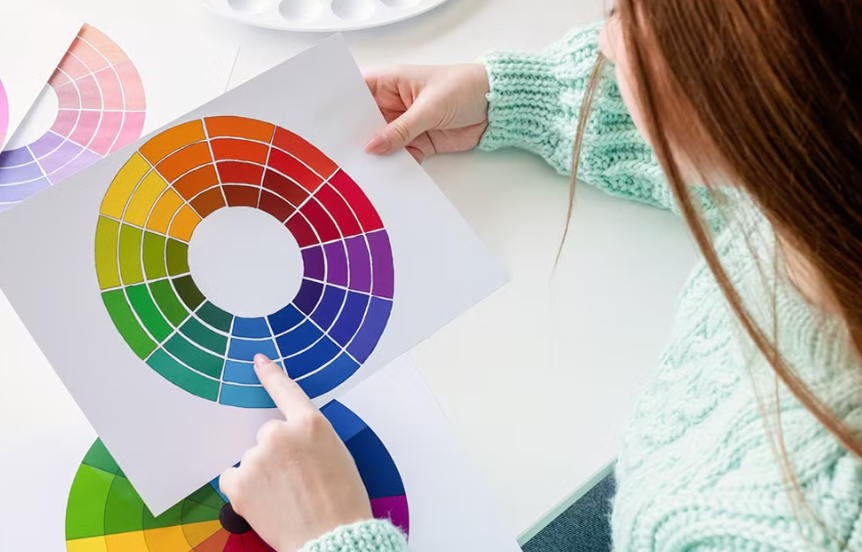
At the heart of color theory lies the color wheel, a circular diagram that organizes colors in a way that illustrates their relationships to one another. The traditional color wheel is divided into primary, secondary, and tertiary colors. Primary colors—red, blue, and yellow—are the building blocks of all other colors and cannot be created by mixing other hues.
Secondary colors are formed by mixing two primary colors: red and blue create purple, blue and yellow yield green, and yellow combined with red produces orange. Tertiary colors arise from mixing a primary color with a secondary color, resulting in hues like red-orange or blue-green. The arrangement of colors on the wheel is not arbitrary; it reflects their relationships and interactions.
Colors that are adjacent to each other on the wheel are known as analogous colors and tend to create harmonious combinations when used together. For instance, blue, blue-green, and green can evoke a serene atmosphere when paired in design or artwork. Conversely, colors that are opposite each other on the wheel are called complementary colors.
These pairs, such as red and green or blue and orange, create striking contrasts that can energize a composition. Understanding these basic principles of the color wheel is essential for artists and graphic designers in Shoalhaven seeking to create visually appealing works.
Understanding Color Relationships
Delving deeper into color relationships reveals a complex interplay that can significantly impact visual perception and emotional response. Beyond the basic categories of analogous and complementary colors, there are several other relationships worth exploring. For instance, triadic color schemes involve three colors that are evenly spaced around the color wheel.
This approach can create vibrant and dynamic compositions while maintaining balance. An example of a triadic scheme is the combination of red, yellow, and blue, which can evoke a sense of playfulness and energy. Another important relationship is the concept of warm and cool colors.
Warm colors—such as reds, oranges, and yellows—tend to evoke feelings of warmth, excitement, and energy. They are often associated with sunlight and fire, making them ideal for creating inviting spaces or stimulating artworks. In contrast, cool colors—like blues, greens, and purples—are linked to calmness and tranquility.
They can evoke feelings of serenity and relaxation, making them suitable for spaces intended for rest or contemplation. Understanding these relationships allows artists and designers to manipulate emotions through their use of color effectively.
The Psychology of Color
The psychological impact of color is a fascinating area of study that has garnered attention from psychologists, marketers, and artists alike. Colors can evoke specific emotions and associations that vary across cultures but often share common themes. For instance, red is frequently associated with passion, love, and urgency; it can stimulate excitement or even aggression.
This is why many fast-food chains use red in their branding—it creates a sense of urgency that encourages quick decisions. On the other hand, blue is often linked to feelings of calmness and trustworthiness. It is no coincidence that many corporate logos feature blue hues; they aim to convey reliability and professionalism.
Green is another color rich in psychological associations; it represents nature, growth, and renewal. This connection makes it a popular choice for brands focused on sustainability or health. Understanding these colour psychology implications allows artists and designers to make informed choices about color usage in their work, ensuring that their intended message resonates with their audience.
Color Harmony and Schemes
Color harmony refers to the aesthetically pleasing arrangement of colors in a composition. Achieving harmony involves understanding how different colors interact with one another to create balance and visual interest. There are several established color schemes that artists and designers can utilize to achieve harmony in their work.
One popular scheme is the monochromatic palette, which involves using variations in lightness and saturation of a single hue. This approach can create a cohesive look while allowing for subtle variations that add depth. Another effective scheme is the complementary color scheme mentioned earlier.
By pairing complementary colors—such as blue and orange—artists can create high contrast that draws attention to specific elements within a composition. Split-complementary schemes offer a variation on this idea by using one base color along with two adjacent complementary colors. This method provides contrast while maintaining some level of harmony.
Additionally, analogous schemes can create serene compositions by using colors that sit next to each other on the wheel. Each of these schemes offers unique opportunities for artists to explore color relationships while achieving visual balance.
See also: Healthy Lifestyles That Can Boost Your Immunity
Using Color in Art and Design
The application of color in art and design extends far beyond mere aesthetics; it plays a crucial role in conveying meaning and emotion within a piece. Artists have long recognized the power of color to evoke feelings or tell stories through their work. For example, Vincent van Gogh’s use of vibrant yellows in “The Sunflowers” not only captures the beauty of the flowers but also conveys his emotional state at the time of painting.
The bold application of color can transform an ordinary subject into something extraordinary by infusing it with life and energy. In design contexts, color choices can significantly influence user experience and brand perception. For instance, websites often utilize specific color palettes to guide users’ emotions as they navigate through content.
A website designed for a wellness brand may employ soft greens and blues to evoke feelings of tranquility and healthfulness, while an e-commerce site might use bright reds or oranges to create urgency around sales or promotions. Understanding how to effectively use color in both art and design allows creators to communicate their intended messages more powerfully.
Color Mixing and Pigments
Color mixing is an essential skill for artists that involves combining pigments to create new hues. There are two primary methods of mixing colors: additive mixing and subtractive mixing. Additive mixing occurs when light is combined; this is commonly seen in digital art or stage lighting where red, green, and blue (RGB) light sources combine to create various colors.
In contrast, subtractive mixing involves pigments or dyes; this method is prevalent in traditional painting where cyan, magenta, yellow, and black (CMYK) pigments are mixed together. Understanding how pigments interact is crucial for artists seeking to achieve specific colors in their work. For example, mixing yellow with blue results in green; however, the specific shades used can significantly affect the outcome due to variations in pigment properties.
Artists often experiment with different brands or types of paint to discover unique mixtures that suit their style or vision. Additionally, knowledge about transparency versus opacity in pigments can influence how layers are applied in painting techniques.
Practical Applications of Color Theory
The principles of color theory have practical applications across various fields beyond traditional art forms. In marketing and branding, companies leverage color psychology to influence consumer behavior effectively. For instance, fast-food chains often use red and yellow in their branding because these colors stimulate appetite and attract attention quickly.
Similarly, tech companies may opt for sleek blues or grays to convey innovation and reliability. Interior design also heavily relies on color theory principles to create desired atmospheres within spaces. Warm colors may be used in dining areas to encourage social interaction while cooler tones might be chosen for bedrooms to promote relaxation.
In fashion design, understanding how colors complement skin tones can guide designers in creating collections that appeal to diverse audiences. In education settings, teaching students about color theory can enhance their understanding of visual arts while fostering creativity. Workshops focused on practical applications—such as creating mood boards or experimenting with different palettes—can empower aspiring artists to explore their unique styles while grounding them in foundational concepts.
Through these varied applications across disciplines—from marketing strategies to interior design choices—the relevance of color theory remains profound in shaping human experiences across cultures and contexts.