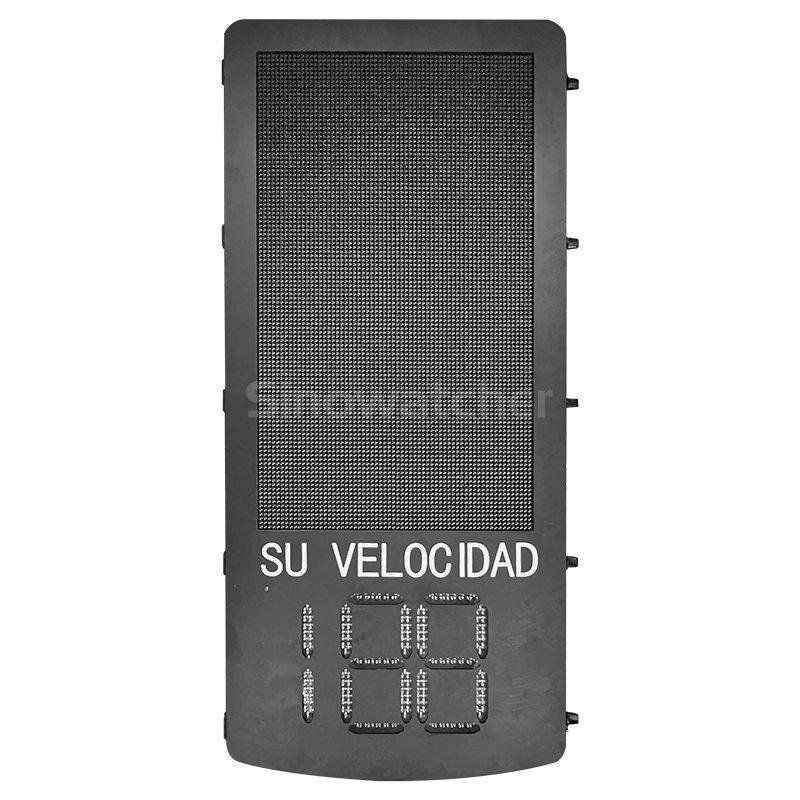

A radar speed display is a roadside sign that measures approaching vehicles and shows their speed back to drivers in real time. A Doppler radar sensor detects each vehicle, and an LED panel displays its speed as it passes. When drivers see a number above the limit, most slow down without enforcement.
These signs are also called a dynamic speed feedback sign or a driver feedback sign. They are among the most widely used traffic calming tools on streets, in school zones, and on rural roads, and knowing how one works helps road authorities choose the right unit and place it well.
What a Radar Speed Display Does
A radar speed display does three jobs at once: it detects an approaching vehicle, measures its speed, and displays it clearly enough to read at a glance. Because it responds to each vehicle individually, it catches attention even on familiar roads.
- Detects vehicles from up to 100 metres away, with 150 m and 200 m options.
- Measures speed from 10 to 250 km/h, accurate to within 1 km/h.
- Changes colour or flashes when a vehicle exceeds the set threshold.
Doppler Radar Detection in Plain Terms
Doppler radar speed detection sends out a continuous radio wave and listens for its echo. The radar in these signs transmits at 24.125 GHz, a frequency well suited to roadside speed measurement. When the wave strikes a moving vehicle, it bounces back at a different frequency: higher for a vehicle moving toward the sign, lower for one moving away.
The processor turns that frequency shift into a speed reading in a fraction of a second. Because it rests on physics, not a camera image, it works in darkness, rain, fog, and glare. The beam covers plus or minus 30 degrees, so it picks up vehicles in the lane beside the sign, not traffic on the opposite carriageway.
- The radar transmits a 24.125 GHz Doppler signal toward oncoming traffic.
- The signal reflects off the vehicle and returns to the sensor.
- The processor measures the frequency shift of the returning wave.
- The shift becomes a speed reading, accurate to within 1 km/h.
From Radar Signal to LED Speed Display
Once the speed is calculated, the LED speed display shows it in bright digits. The LEDs stay legible in sunlight and dim automatically at night. On the Sinowatcher Radar Speed Display ST-RSS500, the display covers 10 to 255 km/h, accurate to plus or minus 1 km/h. Some models add a face-feedback module: a smiling face under the limit, a warning face over it.
See also: Tech Node 927779663 Neural Matrix
Colour Thresholds That Change Driver Behaviour
Colour is the second language of a radar speed display. Speed threshold configuration sets the limit the sign enforces: at or below it, the digits show in green; above it, they switch to red and often flash. The colour removes ambiguity — a driver need not compare the number with a separate limit sign to know they are too fast.
The evidence behind this feedback loop is strong. A Federal Highway Administration demonstration project tested dynamic speed feedback signs at 22 rural two-lane curve sites in seven US states and found mean speed decreases of up to 10.9 mph. The share of vehicles above the posted or advisory speed fell 35 to 70 percent at most sites, and expected total crashes fell about 5 percent, with effects holding after 24 months.
- Set the threshold to the posted speed limit for the road.
- Use green at or below the limit and red above it.
- Review the threshold after roadworks or a limit change.
Power Options for Every Roadside Location
A radar speed display needs power, and manufacturers offer two main options. Solar models use a 60 W, 80 W, or 100 W panel charging a battery that keeps the sign running for 7 to 10 days through rainy weather, which suits rural roads far from the grid. Where mains power is available, an AC 85 to 265 V option runs the sign continuously.
The ST-RSS500 runs on DC 12 V, carries an IP54 rating, and operates from minus 20 C to plus 65 C, with a one-year warranty. Its display-sign model offers weekday and weekend on-off scheduling, so a school sign can switch itself off when the school is closed.
- Choose solar where there is no nearby mains supply.
- Size the panel to local sunlight, using a larger panel in cloudier regions.
- Choose mains power where a reliable supply already exists at the pole.
Speed Data Logging for Traffic Planning
Many driver feedback signs do more than display speeds — they record them. Speed data logging stores each vehicle’s speed and time of passage, and the data can be exported. Engineers use the records to see when speeding peaks and whether a road needs stronger measures.
- Peak speeding hours, which guide enforcement patrol times.
- The share of vehicles above the limit before and after installation.
- Long-term trends that show whether the sign’s effect is holding.
Frequently Asked Questions
How accurate is a radar speed display?
A typical unit is accurate to within 1 km/h across a range of 10 to 250 km/h. The Radar Speed Display ST-RSS500 covers 10 to 255 km/h at the same accuracy.
Does a radar speed display issue fines?
No. It only measures and displays speed to warn the driver. It has no enforcement function and cannot issue penalties.
Can a radar speed display run on solar power?
Yes. Solar models use a 60 W, 80 W, or 100 W panel with a battery that keeps the sign running for 7 to 10 days through rainy weather.
How far away can the radar detect a vehicle?
The standard detection distance is 100 metres, with 150 m and 200 m options for faster roads.
Final Thoughts
A radar speed display turns a simple physics principle into an effective traffic calming tool. Doppler radar measures each vehicle, the LED panel shows the speed back in colour-coded digits, and the instant feedback prompts most drivers to slow down. With solar or mains power and data logging built in, it suits school zones, rural curves, and any street where speed matters.