
Most people don’t remember every gift they’ve received. But many can recall a specific bouquet.
Not necessarily the most expensive one. Often it’s the unexpected arrangement left on a desk, the flowers delivered during a difficult week, or the simple bunch handed over after an ordinary day. The memory lingers because flowers operate differently from most gifts. They don’t serve a practical function, yet they subtly change how a moment feels.
Florists have known this intuitively for decades. Researchers, however, have spent years studying why this happens, and the results are compelling. The emotional effect of flowers is not just cultural tradition; it’s measurable.
Flowers Trigger Immediate Emotional Responses
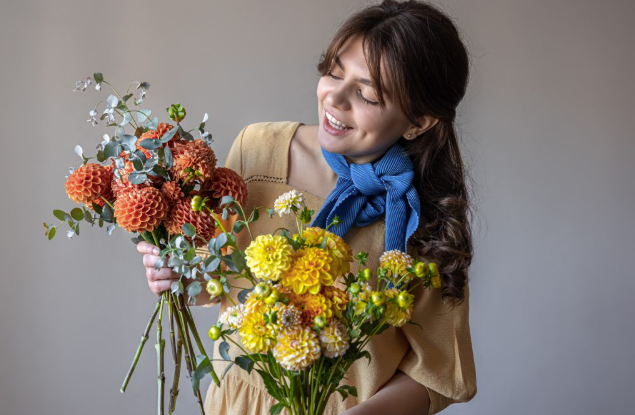
Unlike many gifts that require interpretation, flowers produce an almost instantaneous reaction. People smile. They pause. Their body language shifts.
One study from Rutgers University measured reactions when participants received flowers compared with other common gifts. The results were striking: participants displayed what researchers call “true smiles”, an involuntary facial expression associated with genuine pleasure. Recipients also reported feeling less anxious and more socially connected immediately after receiving the bouquet.
Why it matters: this reaction isn’t delayed or analytical. It happens in seconds. That immediacy is rare in gift-giving.
Flowers engage multiple senses at once. Colour, scent, texture, and visual structure arrive together, creating an emotional signal that the brain processes rapidly. This explains why flowers can change the mood of a room the moment they appear. For the sender, this creates a reliable outcome: a thoughtfully chosen bouquet almost always generates a visible, positive response.
Flowers Strengthen Social Bonds
Gift exchanges help maintain relationships, but not all gifts communicate equally. Items tied to practicality, electronics, clothes, household goods, focus on utility. Flowers operate symbolically.
Research from University of Melbourne exploring social rituals shows that symbolic gifts reinforce emotional bonds more effectively than functional ones. Flowers act as markers of attention rather than tools.
That distinction explains why flowers appear repeatedly during life’s significant moments: birthdays, condolences, anniversaries, apologies, graduations. They convey presence rather than usefulness. They say, “I’m thinking about you right now.” Because they’re temporary, the gesture feels intentional. No one expects flowers to last forever; their value lies in marking the moment, not solving a problem.
Florists understand this dynamic well. Each arrangement becomes a visual expression of the relationship between sender and recipient—a language without words, speaking directly to emotions.
Nature Has a Measurable Effect on Mood
Another reason flowers impact us so strongly is that they bring living elements of nature into everyday spaces.
Psychological research shows that exposure to natural elements—plants, greenery, organic shapes—can influence mood and cognitive wellbeing. Studies referenced by University of Exeter indicate that indoor environments incorporating natural elements are linked to increased positive mood and improved overall wellbeing compared with purely artificial spaces.
Flowers intensify this effect because they are both decorative and alive. Even after being cut, they retain characteristics associated with nature: organic colour variation, subtle scent compounds, and delicate structural forms.
Why it matters: when someone receives flowers, they’re not just receiving an object—they’re receiving a fragment of the natural environment. That presence can soften otherwise clinical or monotonous spaces, such as hospital rooms, office cubicles, or apartments dominated by screens and concrete.
This small shift—sometimes unnoticed—has a meaningful impact on mood. It subtly signals care, warmth, and attention to the recipient’s emotional environment.
The Element of Surprise Amplifies the Effect
Flowers are rarely part of a daily routine. That unexpected element is what often makes the gesture feel significant.
Unlike a coffee delivery or a standard online package, flowers interrupt the everyday pattern. The doorbell rings. A delivery arrives with a handwritten note. The recipient pauses. The moment becomes memorable.
Why it matters: emotional memories form more strongly when events break routine. Unexpected gestures create a moment of narrative disruption. The brain takes notice. That’s why people remember flower deliveries years later, even when they forget other gifts received during the same period.
Local florists who specialise in personalised deliveries understand the power of that moment. Many design arrangements specifically around occasions where surprise matters—birthdays, apologies, or celebrations that weren’t anticipated. Services provided by neighbourhood florists, including studios like Thanks a Bunch, often focus on the delivery experience as much as the bouquet itself. The arrangement matters, but the timing and presentation of arrival matter just as much.
Flowers Translate Emotion Without Words
One of the most practical advantages of flowers is their linguistic neutrality. They communicate emotion without requiring precise wording.
This is especially valuable when words feel inadequate—during sympathy gestures, apologies, or expressions of gratitude. Flowers provide a visual shorthand. Soft whites and greens signal calm and respect. Bright seasonal colours express celebration. Native Australian blooms convey grounded elegance.
Why it matters: the sender doesn’t need a perfect sentence. The bouquet itself carries the emotional message. Florists call this “emotional design.” Colour palette, flower type, and arrangement structure shape the tone intuitively, influencing the recipient without conscious analysis.
See also: Photography Services: Capturing Moments That Last a Lifetime
Why the Tradition Endures
With instant messaging, social media, and digital gift cards, flowers might seem outdated. Yet they remain resilient.
The reason lies in physical presence. A text message disappears into a stream of notifications. Flowers occupy space. They sit on a desk or table for days, quietly reinforcing the sentiment behind the gesture. Each glance refreshes the original emotion, extending the life of the moment beyond its initial delivery.
A Small Gesture With Lasting Impact
The emotional power of flowers isn’t accidental. Research from psychology, environmental design, and social behaviour all point to the same conclusion: flowers influence mood, strengthen social bonds, and create memorable moments.
Florists may speak about beauty and design, but behind those elements lies something more fundamental. Flowers change how people feel—not permanently, not dramatically, but often enough to brighten a difficult day, mark an achievement, or remind someone they matter.
Sometimes, that small shift in emotion is precisely what the moment needed.